Academic IELTS, all four skills, one target band Speaking Writing Reading Listening

Tests measure you. Practice fixes what’s broken.

Take a test in any of the four IELTS skills. Every mistake lands on one Skill Map, and the map decides what you practise next.

An AI examiner for Speaking and Writing, full Reading and Listening papers marked the moment you finish, plus a Foundation Track and vocabulary drills.

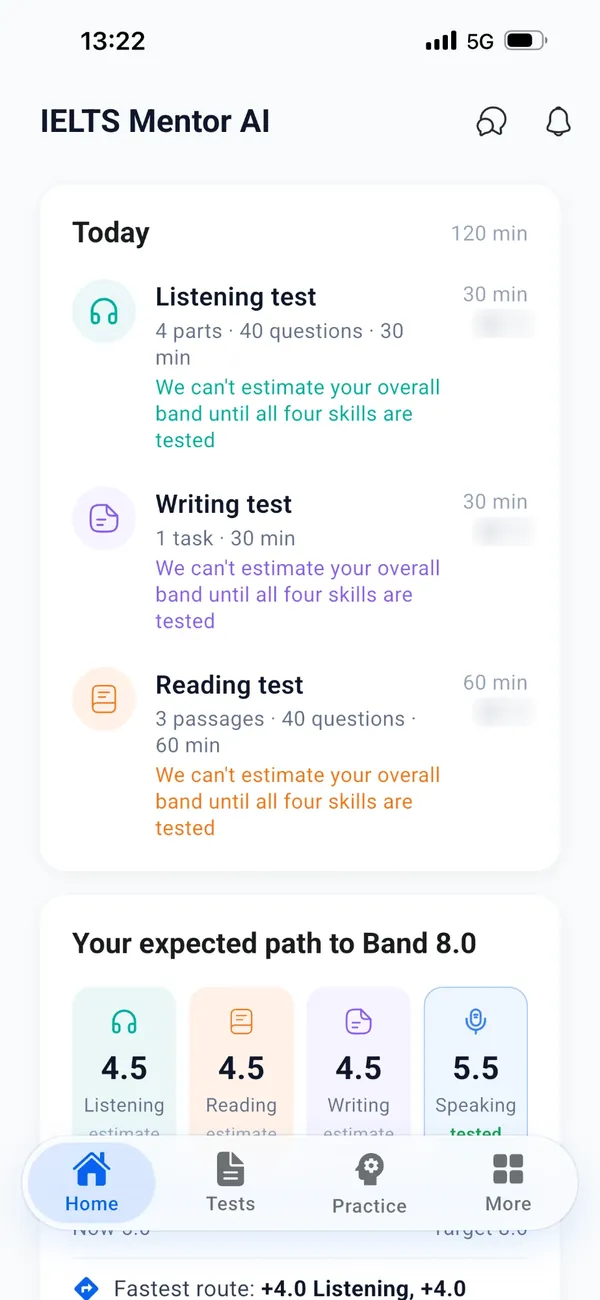
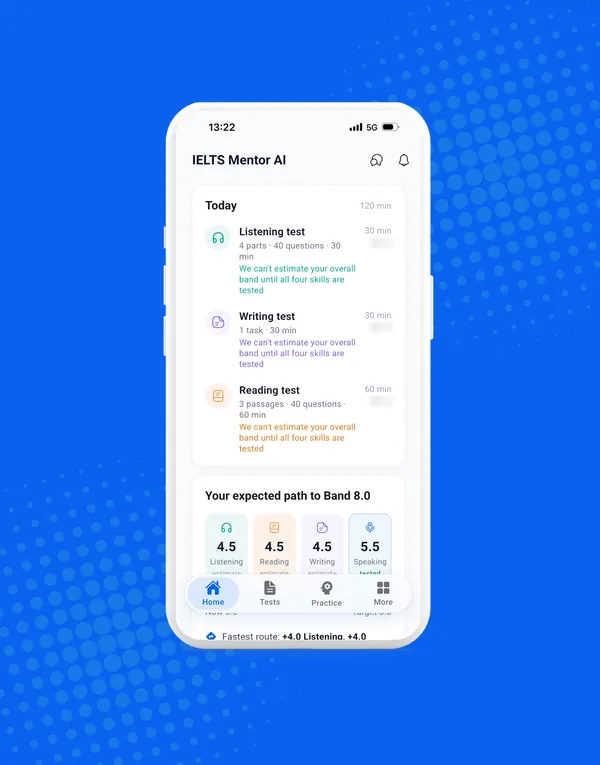
The IELTS Mentor AI home screen: today’s Listening, Writing and Reading tests and the expected path to the target band

Home screen from the app, October 2026.

Four skills

Every skill marked, and every mark explained

Speaking and Writing are marked by an AI examiner on the official criteria. Reading and Listening are marked against the key the moment you submit. All four tell you where the marks went.

Speaking 3 parts · about 15 minutes

Get scored like the real Speaking test.

Sit the full three-part test with an AI examiner, or practise one topic at a time. Every answer comes back with a band and feedback on the four criteria.

  • The full test: Part 1, the Part 2 cue card and Part 3 in one session.
  • A band for each criterion: Fluency and Coherence, Lexical Resource, Grammatical Range and Accuracy, and Pronunciation.
  • Topic Speaking: pick a Part 1, 2 or 3 topic by category, prepare for 60 seconds, speak for up to 2 minutes, and answer the examiner’s follow-up questions.
The app for Speaking
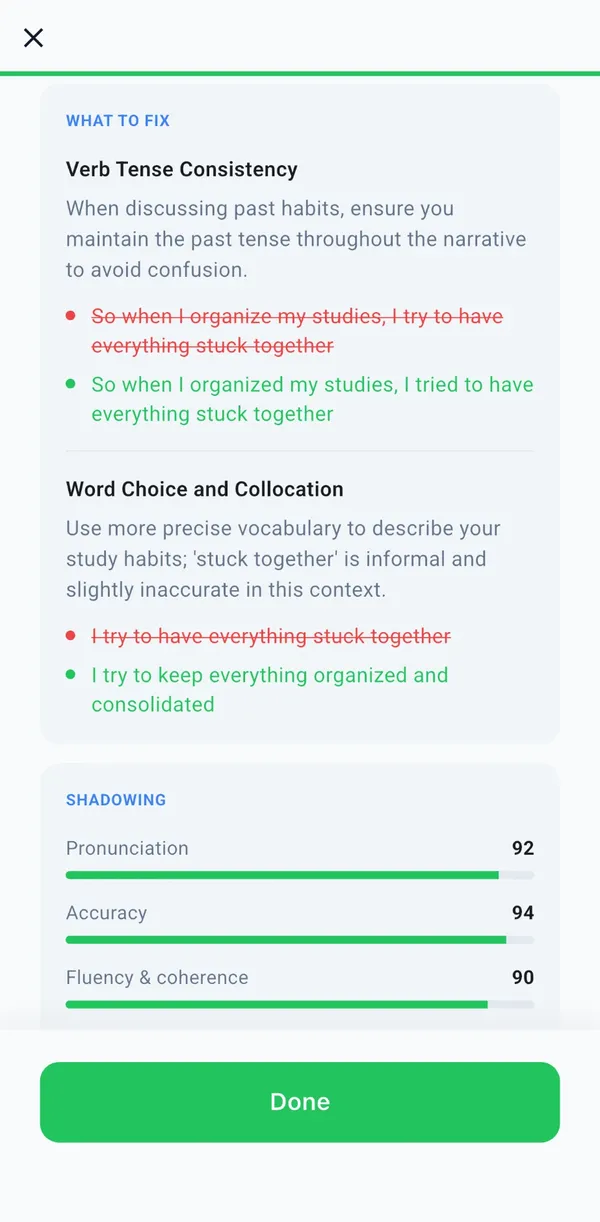
Speaking feedback in the app: what to fix, with a corrected sentence, and the shadowing scores for pronunciation, accuracy and fluency
Speaking feedback screen from the app, October 2026.
Writing Task 1 · Task 2

Feedback that knows the difference between a slip and a habit.

Write under exam conditions and get all four criteria marked, with the mistakes you keep making kept apart from the ones you made once.

  • Task 1 Academic and General Training, and Task 2 essays, in a timed editor: 20 minutes and 40 minutes, with a live word count against 150 and 250.
  • Each criterion marked separately, with a band, what worked and how to improve, plus an Examiner’s Summary and an improved version of your own answer.
  • In Task 1, a Data Accuracy card sets what you wrote next to what the chart actually shows.
  • Wrote it on paper? Attach photos of your answer.
The app for Writing
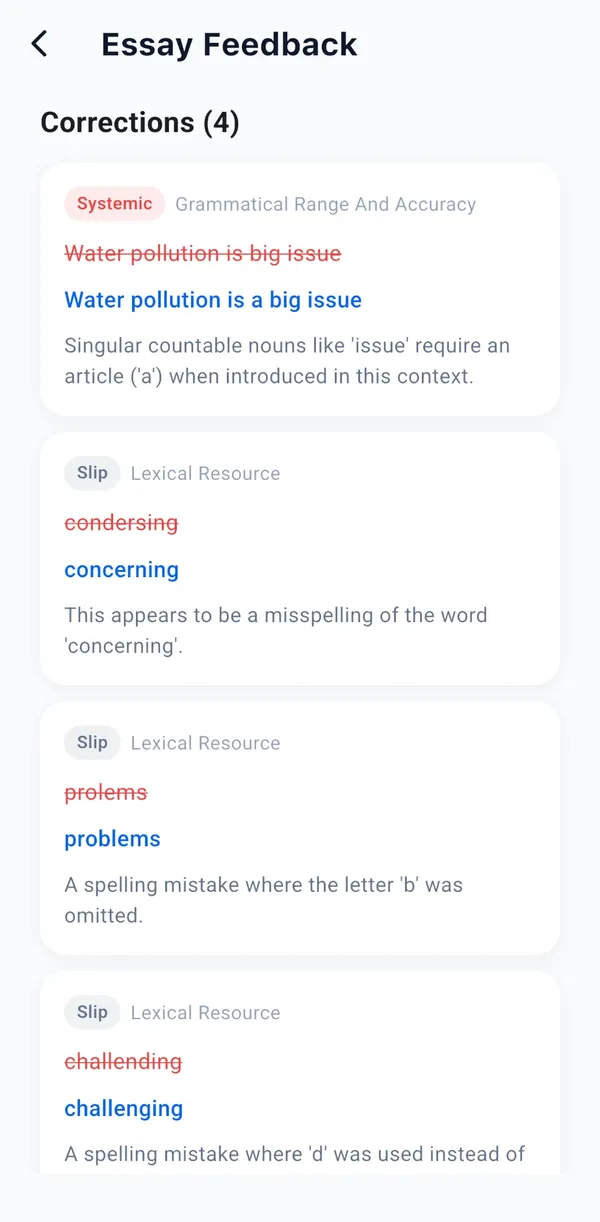
Writing corrections in the app: a systemic grammar error and three spelling slips, each with the corrected form, the criterion and the reason
Writing feedback screen from the app, October 2026.
Reading 3 passages · 40 questions · 60 minutes

Know exactly why the answer was Not Given.

Full Academic Reading papers, marked the moment you finish, with every answer traced back to the sentence that decided it.

  • Three passages rising in difficulty, 20 minutes each. Exam timing submits automatically when time runs out; untimed is there when you want it.
  • Take the whole paper or just one passage.
  • Your band, the time you used, and a breakdown by passage and by question type, with your weakest type flagged.
  • “Show the evidence in paragraph C” opens the passage with the deciding sentence highlighted.
The app for Reading and Listening
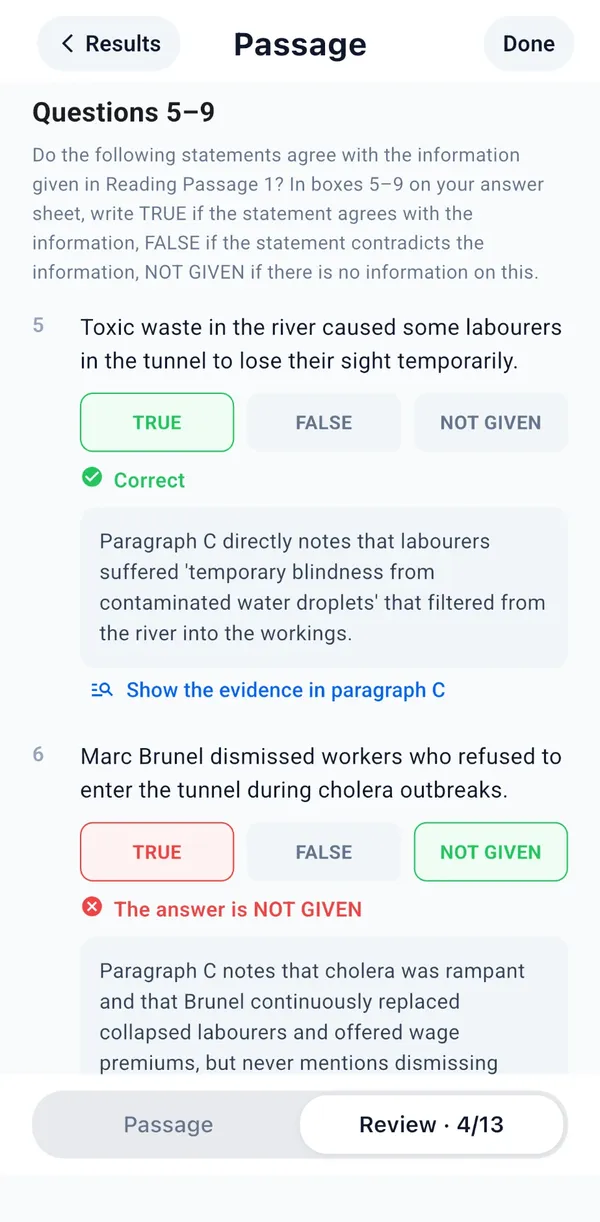
Reading review in the app: True, False, Not Given questions with the right answer, the reason from the passage and Show the evidence in paragraph C
Reading review screen from the app, October 2026.
Listening 4 parts · 40 questions

It plays once. Just like test day.

Full Listening tests, four parts from easiest to hardest, then one tap to hear the exact line you missed.

  • Exam mode plays each recording once, with 30 seconds to read before each part, 2 minutes to check at the end, and automatic submission. Practice mode lets you pause and replay, and the results say which mode you took.
  • British, Australian and American speakers, and the traps that cost marks: self-corrections, spelled-out names, “ONE WORD ONLY”.
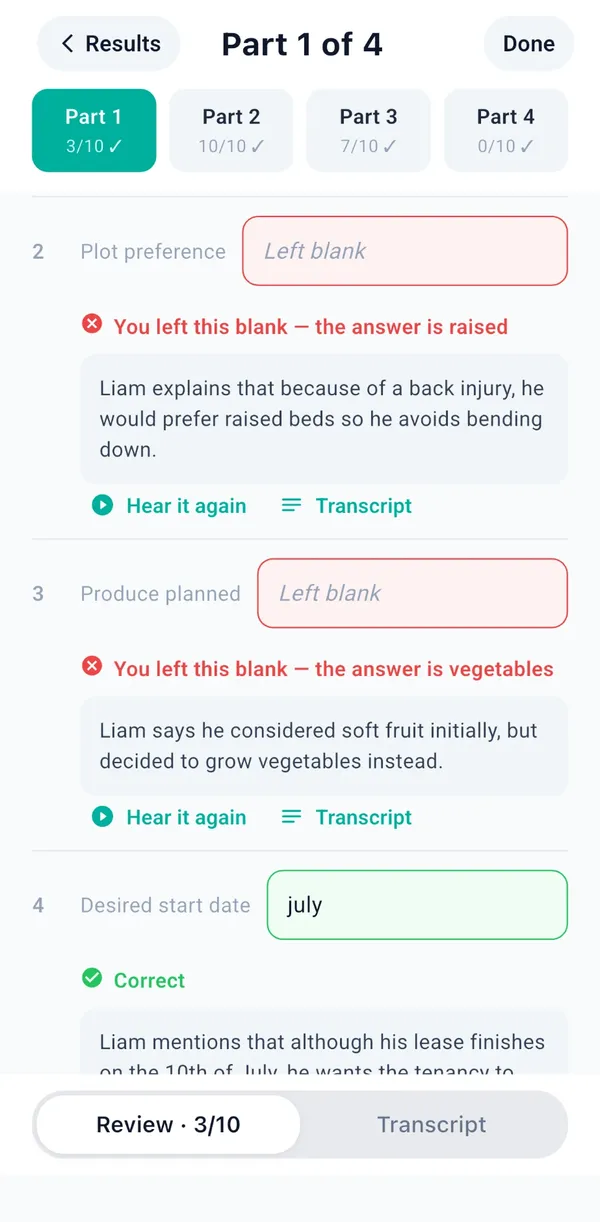
  • “Hear it again” replays the line with the answer, and the transcript opens with that line highlighted.
  • “Heard it, spelled it wrong” tells a listening miss from a spelling miss.
The app for Reading and Listening
Listening review in the app: Part 1 of 4, an answer left blank with the right answer and the reason, and the Hear it again and Transcript buttons
Listening review screen from the app, October 2026.
How it connects

Four skills. One plan. One number that matters.

A score on its own doesn’t tell you what to practise tomorrow. Here every test you take updates one Skill Map, and the map decides your next session, so you never open the app wondering what to do.

  1. 1

    The Skill Map

    Every test feeds one map of the language behind your answers: articles, tenses, cohesion, collocations, prepositions, word form and more, each shown as a percentage.

  2. 2

    The Skill to Fix First

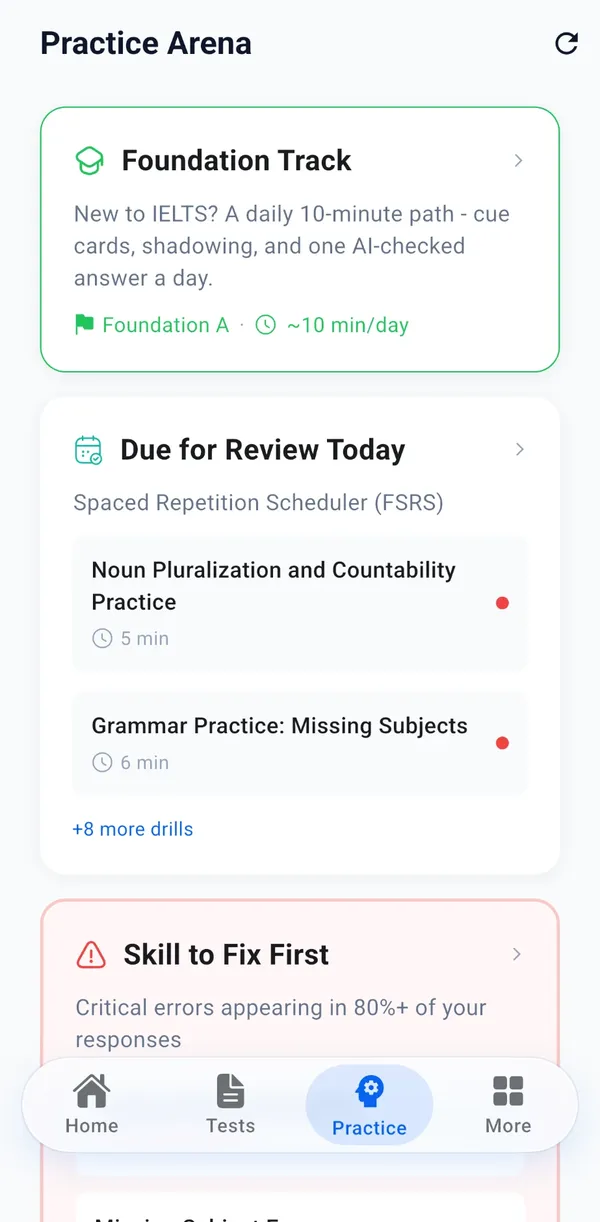
    The critical errors that appear in 80%+ of your responses go to the top. A mistake you make in both your writing and your speaking is one gap, not two.

  3. 3

    Review Due, Quick Wins and Blocking Issues

    Review Due brings back what you are about to forget, on a spaced-repetition schedule. Quick Wins are short drills with a fast payoff. Blocking Issues are the recurring errors, shown with your own sentence and the corrected form.

  4. 4

    Your expected path to the band

    From where you start to the band you need, updated as you practise, so you can see whether today’s session moved you.

Practice Arena in the app: the Foundation Track, the reviews due today and the skill to fix first
Practice Arena screen from the app, October 2026.
Foundations

Start where you are, and build the words you’re missing

Two parts of the app that sit alongside the tests: a short daily path for Band 3–5 candidates, and a vocabulary trainer built around the words that move a Lexical Resource band.

Foundation Track

Not ready for a full test? Start here.

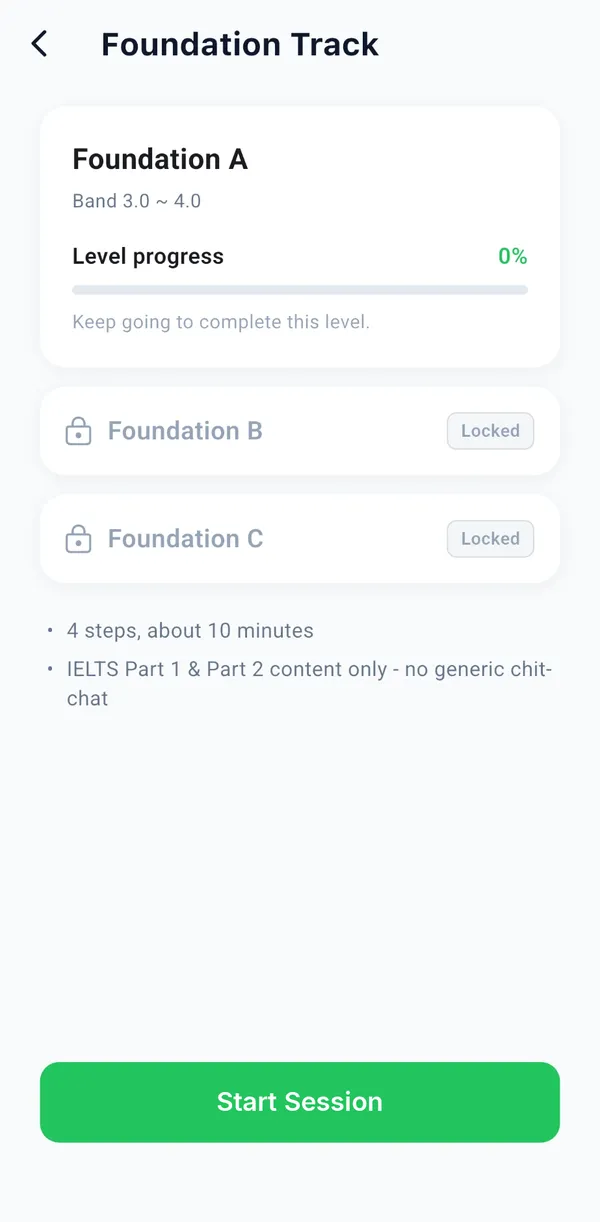
A daily path of about 10 minutes for candidates around Band 3–5, with IELTS Part 1 and Part 2 content only. Three levels, A (Band 3.0–4.0), B and C, unlock in order.

  1. Warm-up Five words, with the meaning and the audio.
  2. Listen & Shadow Repeat a sample answer and get feedback on your pronunciation, word by word.
  3. Pattern Drill Complete sentences by tapping, not typing.
  4. Your Turn One real IELTS question, up to 60 seconds, checked by AI.

You get an estimated band, the four criterion bands and what to fix, while a readiness meter and a streak keep the habit going.

The Foundation Track in the app: Foundation A for Band 3.0 to 4.0 with its level progress, and Foundation B and C locked until A is complete
Foundation Track screen from the app, October 2026.
Vocabulary

The word list that knows which words you’re missing.

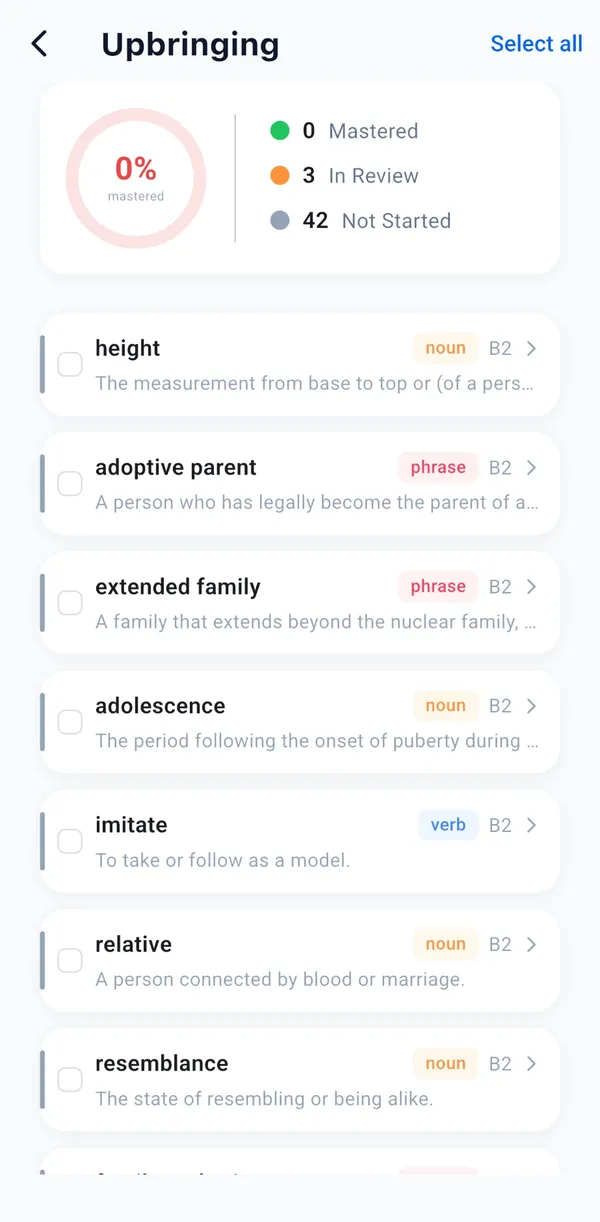
Over 1,100 IELTS words in topic clusters, each with a definition, an example sentence, its collocations, its word family, audio and a CEFR level.

  • Four drills: Speak in Context, Upgrade Drill, Collocation Builder and Word Form Switch.
  • Word Gaps, built from the words you overuse, with what to say instead.
  • Spaced repetition: words come back in Review Due right before you would forget them.
  • A Lexical Map that tracks vocabulary on its own, because IELTS marks Lexical Resource on its own.
A vocabulary topic in the app, Upbringing: words mastered, in review and not started, each word with its part of speech, CEFR level and meaning
Vocabulary topic screen from the app, October 2026.
Practice library

62 cue cards, each with practice mode

Each card has a one-minute preparation timer, the same answer at Band 6, 7 and 8, the common mistakes and the Part 3 questions that often follow.

Browse the library →
Real scored output

The same answer at Band 6, 7 and 8

This is a real excerpt from our cue-card library — the story never changes, only the language does. Tap a highlighted phrase to see what an examiner would notice about it.

Band 6

I want to talk about my elderly neighbour, Mrs. Aliyeva, who liveSubject-verb agreement error: should be “lives” alone a few doors from my family. About two years ago, she breakTense slip: should be “broke” her wrist after a fall and suddenly she cannot do basic things like carrying shopping bags or even opening jars, which was obviously a tough spot for someone who lives alone. My mother noticeTense slip: should be “noticed” she was struggling one afternoon and asked me if I could step in and help until her wrist got better.

Band 7

I’d like to talk about an elderly neighbour of mine, Mrs. Aliyeva, who lives alone a few doors downNatural, precise phrasing from my family. About two years ago, she broke her wrist after a fall and suddenly couldn’t manage basic things like carrying shopping bags or even opening jars, which was obviously a tough spot for someone living by herselfNon-defining relative clause used naturally. My mother noticed she was struggling one afternoon and asked if I could step in and help out until her wrist healed properly.

Band 8

I’d like to talk about an elderly neighbour of mine, Mrs. Aliyeva, who lives alone just a few doors down from my family. About two years ago, she broke her wrist in a fall and suddenly found herself unable to manage basic thingsNatural complex verb structure like carrying shopping bags or even opening jars — a genuinely tough spot for someone living on her ownPrecise, idiomatic phrasing. My mother noticed she was struggling one afternoon and asked whether I could step in until her wrist healed properly.

Explore

Start with what you need

Every one of these runs in your browser: no sign-in, nothing uploaded.

Mock test

Full mock test

Part 1, a cue card with the one-minute prep, then Part 3 — timed end to end in your browser.

Sit the mock →
Cue cards

IELTS Speaking cue cards

62 commonly reported Part 2 cards, each with practice mode and a sample answer.

Open the library →
Questions

Speaking questions by topic

Part 1 and Part 3 questions in 44 topics, each with a line on how to extend the answer.

Browse the topics →
Self-assessment

Speaking self-assessment

Twelve questions, three minutes, an estimated band range and what to fix first.

Estimate your band →
Vocabulary

Vocabulary by topic

Band 6, 7 and 8 phrases for 12 topics that come up, with a self-test on every page.

Browse the topics →
Pronunciation

Word stress trainer

Hear one of 96 words, tap the syllable you think carries the stress, and drill the rules you keep missing.

Start drilling →
Study plan

Study plan generator

A week-by-week plan around your test date: a weekly focus, real cue cards and a daily session.

Build your plan →
Writing

Essay checker

Paste a Task 2 draft and check its length, paragraphs, position, linking and repetition.

Check a draft →
Quick answers

The IELTS Speaking test, answered

106 short pages that answer the exact questions people search about the Speaking test, each checked against the official IELTS pages.

Browse the answers →
Everything else

All tools and calculators

The band score calculator, the Speaking and Writing band descriptors, and every other tool on one page.

See all 15 →
How it works

How it works

From your first test to the band you need, in four steps.

1

Set your target

Tell the app the band you need and when you sit the exam, so your plan has a finish line.

2

Take a test

Open Tests and pick a skill: a full paper, or one part, passage or task at a time.

3

See where the marks went

Your band, the criterion feedback, the evidence in the passage and the line in the transcript, on one results screen.

4

Practise what the Skill Map picks

The Skill to Fix First, Review Due and Quick Wins set your next session, and your path to the target band updates as you go.

Frequently asked questions

What IELTS Mentor AI covers, how each skill is marked, and where to start.

What does IELTS Mentor AI cover?

All four skills of Academic IELTS: Speaking, Writing, Reading and Listening. Speaking and Writing are marked by an AI examiner on the official criteria; Reading and Listening are full papers marked against the key the moment you submit. Every test feeds one Skill Map, and the app also includes a Foundation Track for beginners and a vocabulary trainer with over 1,100 IELTS words.

Is it for Academic or General Training?

Academic IELTS. The Reading papers are Academic. Writing Task 1 covers both Academic (charts, graphs, tables and maps) and General Training, and Task 2 essays are the same for both. Listening and Speaking are the same test whichever version you sit.

Does it cover Listening and Reading?

Yes. Reading gives you full Academic papers: three passages, 40 questions and 60 minutes, with exam timing or untimed, and a review that highlights the sentence behind every answer. Listening gives you full four-part tests with 40 questions, in Exam mode (the recording plays once) or Practice mode (pause and replay), and a review where you can hear each answer's line again and read it in the transcript.

How does the AI score my Speaking?

The AI examiner runs the test with you: the full three-part test takes about 15 minutes, and Topic Speaking lets you practise one topic with follow-up questions. You get a band and feedback on the four official criteria (Fluency and Coherence, Lexical Resource, Grammatical Range and Accuracy, and Pronunciation), and the mistakes that keep coming back go to your Skill Map.

How is my Writing marked?

Each Task 1 or Task 2 answer gets a band for each of the four criteria, with what worked and how to improve, and an Examiner's Summary. Task 1 answers also get a Data Accuracy card that compares what you wrote with what the chart shows. Recurring mistakes are kept apart from one-off slips, you see an improved version of your own answer, and you can type your answer or attach photos of a handwritten one.

What is the Skill Map?

One map of your English, fed by every test you take: articles, tenses, cohesion, collocations, prepositions, word form and more, each shown as a percentage. It picks the Skill to Fix First (the critical errors that appear in 80%+ of your responses) and feeds Review Due, which brings items back on an FSRS spaced-repetition schedule (FSRS is an open-source algorithm) just before you would forget them.

I'm a beginner. Where should I start?

With the Foundation Track: about 10 minutes a day for candidates around Band 3–5. Each session has four steps (a five-word warm-up, listen and shadow, a pattern drill and one spoken answer checked by AI), and the three levels, A, B and C, unlock in order.

How do I get started?

Download the app, set your target band and exam date, and take your first test in any of the four skills. The Skill Map starts filling in from that first test.

Can I use this on both iOS and Android?

IELTS Mentor AI is available on both the App Store and Google Play.

Before you download

Is IELTS Mentor AI for you?

You came here with a band to reach. Here is who the app is for, who it is not for, what happens if it does not work for you, and what it does not promise.

It is for you if

  • You are preparing for Academic IELTS and practise on your own.
  • You want your Speaking and Writing assessed against the four official criteria, with a band range rather than a single guess.
  • You want full Reading and Listening papers under exam timing, with the evidence behind every answer.
  • You can use an app whose interface is in English; this site explains it in eighteen languages.

It is not for you if

  • You need the General Training Reading paper. It is not in the app.
  • You want an official score. The app reports a range, and it is not affiliated with IELTS, IDP, the British Council or Cambridge.
  • You want to practise without a phone. The app runs on iOS and Android; the tools on this site are the browser part.

If it does not work for you

IELTS Mentor AI is a paid app. The plans, the packs and what each one buys are on this site, and the App Store or Google Play show the terms before you confirm; how billing and refunds work is written down in plain words, and support answers by email.

What it does not promise

A range, not a result. Speaking and Writing come back as a band range from strict to lenient, with the sentences that moved it, because no software can promise the band an examiner will give; only the test does. Whether AI scorers work sets out the evidence.

Academic IELTS, all four skills

Practise only what you need to improve.

Start with a real score, not a guess.

Take a test in any of the four skills. The Skill Map remembers what went wrong, and your next session starts there.

IELTS Mentor AI on a phone, showing the home screen